What is slab faulting, and why it drives taxiway rehab scheduling
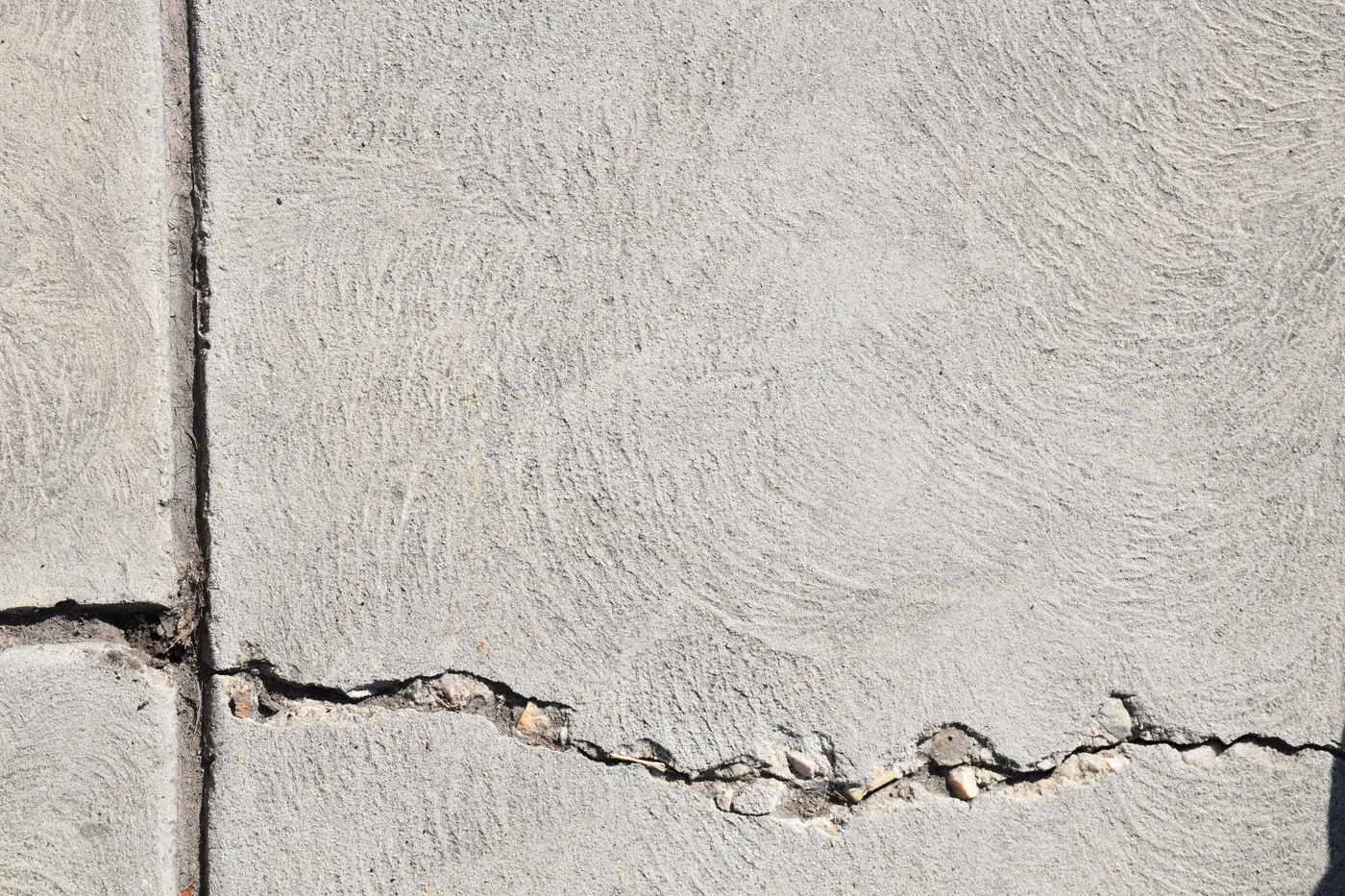
Walk a rigid pavement joint with your hand flat across it and you'll feel faulting before you ever measure it. One slab sits a few millimeters higher than its neighbor. Roll a wheel load across that step enough times and the gap only gets worse.
Faulting is the vertical displacement between two slabs at a joint or a transverse crack, and it's fundamentally a load-transfer problem. When joints lose their ability to pass load from one slab to the next, usually because the dowel bars have worn loose or corroded, or because fines have pumped out from under the slab, one side starts carrying more of the wheel load than the other. That slab deflects more under traffic, water works its way into the gap, and the erosion under the approach slab accelerates. The fault grows a little with every heavy aircraft that crosses it.
How faulting differs from the other distress types on your field
Concrete pavement engineers lump a handful of distress modes together on a PCI survey, and it's worth keeping them straight because they point to different causes and different fixes. Corner breaks are a slab cracking off at the corner, usually from a combination of loss of support and heavy wheel loading near the joint. Spalling is the chipping and breaking of concrete right at the joint face, often from incompressible material jammed in the joint or from corroding dowels expanding and pushing the concrete apart. D-cracking is a durability problem inside the aggregate itself, showing up as a pattern of fine cracks parallel to the joint. Scaling and map cracking are surface-level and rarely structural on their own.
Faulting sits in a different category. It's a structural symptom you can measure in millimeters, and FAA and ICAO distress manuals both treat it as one of the heavier-weighted inputs into the pavement condition index for rigid sections. A taxiway with moderate faulting at a cluster of joints scores worse, and triggers a closer look, well before the slabs look visibly cracked or broken to someone driving the perimeter road.
Why the rate of faulting matters more than the snapshot
A single faulting reading tells you where a joint stands today. It doesn't tell you how fast it got there, and that's the number that actually drives a rehab schedule. A joint that faulted 3 mm over five years is a different maintenance problem than one that faulted 3 mm in the last eighteen months. The second one is pumping actively, probably has standing water finding its way under the slab after every rain event, and will keep accelerating until something intervenes: diamond grinding to restore the ride and level the step, dowel bar retrofit to put load transfer back, or full slab replacement if the subgrade support is gone.
Most pavement management plans schedule rehab off a PCI threshold and a design life curve. Faulting progression is what tells you whether a given taxiway section is tracking that curve, running ahead of it, or has stabilized. Catching that trend early means a grinding and dowel bar retrofit program instead of a full reconstruction three years sooner than the pavement management plan assumed. Missing it means the faulted joints keep taking traffic until someone flags a rough-ride complaint from a crew and the condition has already moved past the point where grinding alone fixes it.
The catch is that tracking a trend requires more than one data point, and the inspection that produces that data point is usually a full-closure walking survey. On an active taxiway or apron, that's a scheduling fight every single year, which is exactly why a lot of airports end up with faulting data that's three or four years stale by the time anyone reruns the survey.
Pavement Survey is built around that specific gap: an annual overhead read of the movement area's joints and surface condition at a resolution fine enough to track faulting and joint distress year over year, without putting a closure window on the schedule to get it. If your taxiway rehab plan is running on condition data that's older than your last repaving project, it's worth seeing what a yearly read without a closure gets you.